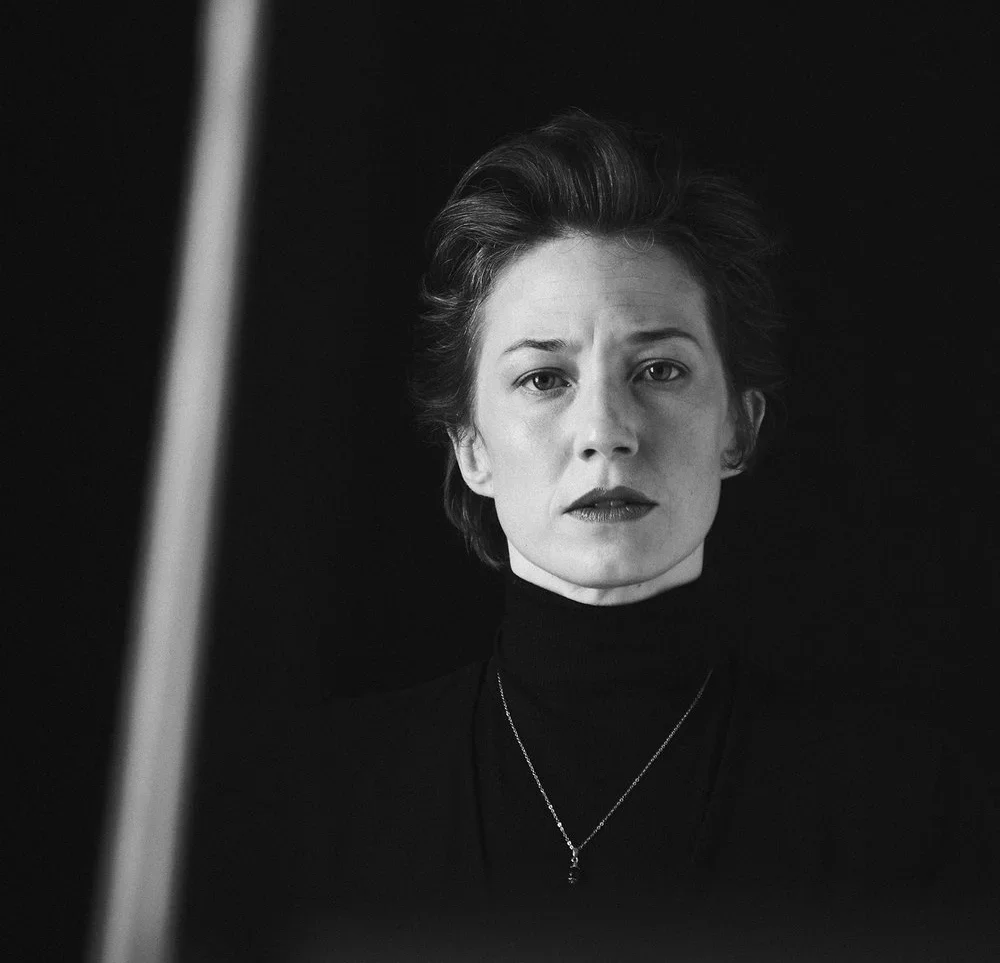
Carrie Coon: The Laterals
Some actors become stars overnight. Others never even reach the Earth's stratosphere. For Carrie Coon, she became a star the very moment she stepped on stage in the revival of Who’s Afraid of Virginia Woolf? She skyrocketed into stardom without the glitterati or the Hollywood pretense—earning a Tony nomination in the process. Even NASA didn’t see her coming.
Carrie never aimed to be a star; that was never the goal. She grew up in Akron, Ohio, with deep familial roots dating back to the 1800s. The second of five children, she was raised to value experiences over material things. She was very much the academic, earning a Bachelor's in English and Spanish, as well as an MFA in Acting from the University of Wisconsin-Madison. She made a modest living making her rounds in local theater, shooting commercials and doing voice-over work. She eventually moved to Chicago and landed that momentous role in the Edward Albee play. It not only catapulted her career, but she also met her Pulitzer Prize-winning playwright husband, Tracy Letts, who played one of the leads in Woolf.
After her Broadway run, Carrie broke into the mainstream alongside Ben Affleck in Gone Girl. She followed with an outstanding role as Nora Durst, a woman contorted by grief, in HBO's The Leftovers. Her character tries to reconcile her life after the loss of her husband and two children in the "Sudden Departure," a rapture-like event where 2% of the population disappears. In the beginning, Nora Durst has a fragile determination that's charged by Carrie's unique dexterity. It’s also important to note her capacity to cry, like really cry. It’s an arsenal ranging from ugly to a single tear with a quivering lip, except with finesse. By the end of the show, her character becomes an absolute force —a zealot who claims one of 2017's best TV moments; alongside Regina King, she jumps on a trampoline with Protect Yo' Neck playing in the background, all in slow motion. If you haven’t seen it, you’re missing out.
Before The Leftovers ended, Carrie landed a role on FX's anthology series Fargo. She plays the folksy, yet resolute police chief Gloria Burgle, who is facing one of the lowest points in her personal life. In this role, Carrie blurs the line of morality, making you question whether you should root for her, question her, or both at the same time. Unlike other archetypal lady-cop Fargo characters, she gets lost, breaks the rules, and it couldn’t be more awesome. Her performance is beautifully composed, deeply unsettling, totally satisfying, wholly unsatisfying, and constantly keeps you thinking. She was nominated for an Emmy.
We had a hard time finding the right mot juste—or exact words — to describe Carrie Coon. There is no easy way to decipher her fierce talent and dynamic persona. Her acting chops: superb. Her emotional range: remarkable. Her aptitude for subtleties: ingenious. Her mastery of taking you in and never letting you go: striking. Even in the darkest moments as an actor, Carrie can find the humor… and the hope. Her work includes some heavy characters, but Carrie IRL (in real life) is light and funny and has a potently intriguing Midwestern charm. In essence, Carrie Coon is brilliant. As brilliant as any star you can find across the universe. And more than anything, we can't wait to watch her win that Emmy.
Your very first feature film credit was Gone Girl, which is quite the accomplishment. Were you always the overachiever?
Yes! I’m the middle child of five, so I tried to get attention by being good at things and “earn” love by being helpful. Truthfully, my family tells me I was bossy, energetic, and didn’t require much sleep, so there’s a nature vs. nurture argument in there somewhere. In school, I was class president for 5 years, captain of both my sports teams, and my 4x400 relay team won the state championship my freshman year. I was a straight-A student, never skipped class in college, and I didn’t drink. That all sounds textbook type-A, doesn’t it? I’m also an Aquarius, though, so I may be a rule-follower, but I have an unconventional streak. And I have been a very gifted liar in my life, though I’ve since given that up.
We are ecstatic to see you nominated for your role in Fargo, congrats! Where were you when you found out, how did you react, and what does it feel like to get your first Emmy nomination? Tell us all.
I had a very typical morning in our apartment in Tribeca: I read the New York Times with my coffee and ate some oatmeal. I had just finished doing the dishes when I hopped in the shower, not realizing it was about 11:22 am. By the time I came out to the living room, my husband Tracy had the nominations streaming on our Apple TV. My phone rang about five seconds later, and it was my best friend Tona, a Civil Rights attorney for the US, who was watching in the airport. After that, it was all press until I headed off to a working lunch with a couple of theater types, and we had a glass of champagne to celebrate.
Your character, Gloria Burgle, is so interesting, especially because she is the chief of Eden Valley Police yet is constantly undermined by her male bosses. Being the overly capable, underestimated lady cop must have been frustrating. What was your takeaway from this?
Let’s just say I’m afraid most women can relate. And I attended the Women’s March in DC.
You are originally from the Midwest as well (Ohio, to be exact). What is the most “Midwest” thing you have ever done, eaten, or used to hone your character for Fargo?
As you point out, I’m from Ohio, so I suppose everything I’ve ever done prepared me for Gloria: eating casseroles, playing in the snow for hours, driving a sensible vehicle, going to the local library, stoically enduring hardship without complaint, expressing my displeasure in a manner one might refer to as “passive-aggressive.”
The Leftovers was a truly bittersweet end to such a great show. Your character Nora Cursed was especially intriguing. How did you develop her over the years? Were there parts of her that you connected to or simply couldn’t identify with?
My friends who are parents cannot even entertain a thought of the possible harms that might befall their children without having an immediate emotional response. I don’t have children yet, and I never wanted Nora’s process to feel inauthentic or trite to those who have experienced similar unresolved filial grief. Shortly after I was cast, I heard an interview with Sonali Deraniyagala on NPR about her memoir, Wave, which is a spare, unstinting examination of her life after losing her husband, parents, and two sons aged seven and five in the tsunami in Sri Lanka in 2004. Her unfathomable experience is the nearest factual equivalent to Nora’s, and her book was my touchstone. Her language opened an empathetic space for me that I couldn’t have found alone and I was rarely without it, especially on the most emotionally demanding days of scene work. As for character development, it’s a very organic process when scripts are well written. So much of what an actor requires is on the page, and the rhythms are learned and stored in the body. The beginning of a season was always a little uncomfortable for me because I had been away from Nora doing other things. It feels like putting on a wet bathing suit: you know it’s yours, and it will feel fine once it warms up, but wriggling into it is awkward.
Now that The Leftovers has come to an end, leaving us in a suspended and superb state of disbelief, do you have a sense of closure? Do you think the characters do?
I finished shooting season three in Australia in September, so by the time it aired, I had already shot Fargo in its entirety. I would venture that many actors are accustomed to our profession’s swing between compressed, intimate, finite time with a peer group and a return to solo entrepreneurship. It’s arguable whether it’s lonelier to be on the road for a job or to hustle at home, but you can’t deny that actors mastered the gig economy before it “disrupted” traditional employment models. We shot the LADR scene last, so I was the only cast member left in Melbourne. I was alone for hours in a bowl full of water as naked as the day I was born, which struck me as an appropriate way to say goodbye to Nora. It was humbling to be so literally stripped down. It brings to mind one’s own insignificance, which, if you think about it, is the lesson Nora learns from her journey as described to Kevin (whether you believe her or not). Kevin arrives at her doorstep with a dignified amount of newfound (and likely hard-won) serenity, and the finale's circumstances force a breakthrough in self-forgiveness for Nora. I’d say that’s a healthy place from which to start over.
The cast of The Leftovers was truly dynamic. After 3 seasons, you must have had some great moments with the cast and crew. Share your favorite behind-the-scenes story with us.
It is such a pleasure to watch the scenes I’m not in because we had the deepest acting bench on television. As Nora, I often worked alone or with Chris and Justin, both of whom I adore. It was a rare gift to have a scene with any of the extraordinary actresses on the show. My last day with Regina King, the trampoline scene in season three, was particularly bittersweet. We shot the tattoo monologue first, which was hard for me, but speaking with Regina's talent made it so much easier. We set up the trampoline to film during magic hour (that’s sunset), and Regina and I are both athletic, so we were looking forward to it. Imagine jumping around to Wu-Tang at sunset with Regina King, then lounging on a trampoline between takes and enjoying good company. Is there anything better? At one point, our director Keith Gordon had me jumping really high while laughing… Unfortunately, our night was cut short when I accidentally “popcorned” Regina and she twisted her ankle and had to go to the hospital. It’s customary to applaud an actor on their season-wrap day, and we didn’t have the chance to give her a proper farewell. The Leftovers could be heavy, but there was also a lot of joy.
You’ve had such range in your career, from Who’s Afraid of Virginia Woolf? on Broadway to attempting a heist in Steve McQueen’s thriller Widows, set for release in 2018. Is there a particular role or genre you are dying to try out?
Comedy! First, let me say that I would relish an action film, but my family is at a loss to understand why I play dark, heavy, sad, unhinged people when they see me as easygoing, and even silly. Am I practical? Yes. Dry? Absolutely. But my Grandma Dee always wanted to see me play Billie Dawn in Born Yesterday on stage, which is one of the great comic roles. When I work with directors who only know me from my work, they’re often stunned by my lightheartedness. I work hard and focus on set, but I’m not fussy or particularly serious. On the rare occasions I’m recognized on the street, fans of the shows often remark on the disparity between their preconceptions and who they actually meet.
If you weren’t acting, what other career endeavors would you pursue?
When I was in graduate school at UW-Madison (a program that, unfortunately, no longer exists due in part to Scott Walker’s drastic funding cuts), our voice classes were the source of my most potent personal and artistic discoveries. I attended a workshop at the Roy Hart Center in France during my tenure, and I witnessed firsthand the transformative power of freeing the voice in a group of women who were not actors or performers. I would like to help other women ground their voices in their bodies. When your voice isn’t rooted, when you aren’t breathing all the way to the floor, you give up your power in a room. I actually don’t think we can reach gender parity in politics and business until we are willing and able to resonate in a room without effort.
Considering all the roles you’ve played, you’ve done a lot of crying. What do you do to shake off the heavy moments?
What’s challenging about those scenes for me isn’t shaking them off, but rather repeating them over multiple takes. In the theater, you build to the climactic crying moment and then do it once—and that’s after rehearsing the play for weeks. In television and film, you have a cathartic cry, and then you have to stuff it all back in and start again, which runs counter to the very nature of catharsis. I’ve always believed actors are healthier when they're fully expressed. Most jobs don’t give one space and permission to cry, or punch, or smash, or fuck, or fly.
The Papers will be released this holiday season. Tell us more about this project.
This Stephen Spielberg film is based on a script by Liz Hannah and Josh Singer, and it tells how the Washington Post came to publish the Pentagon Papers after the New York Times was prevented from doing so pending a lawsuit by the federal government. Meryl Streep plays Katherine Graham, who had only recently taken over the paper following her husband’s suicide, and Tom Hanks is Ben Bradlee, executive editor. I play Pulitzer Prize-winning journalist Meg Greenfield, a deputy editor at the time who became a close friend of Katherine Graham after the controversy. There are over 100 speaking parts, so it will stand as a time capsule of TV and Film culture in 2017. There are entire regions of the country where folks knew little to nothing about the disclosures of the Pentagon Papers or felt that Daniel Ellsberg was guilty of treason. The battle to expose the government’s actions was happening on the coasts and in the cities, much like our current constitutional crisis, except now journalists are struggling against an attempt to discredit their entire profession. The truth is under siege, and without facts we cannot have rational argument and reasonable compromise. Needless to say, I find the film's timing apt and its themes germane.
Some people may not know this, but you were an English major. If you were stranded on an island and could bring only one book, what would it be?
That would probably be a good time to tackle Marcel Proust’s Remembrance of Things Past. It’s seven volumes, so it would keep me occupied for a very long time. If I were stranded on an island without a book, I would surely die, but perhaps I’m underestimating my own spiritual potential. Would Proust prevent me from reaching enlightenment or nudge me closer? We may never know. Do you think Amelia Earhart achieved enlightenment?
In doing our own research for this feature (we may have gone deep into your Instagram), we noticed you show a ton of love for your colleagues. When you aren’t starring in two hit series, what are you binging on?
Halt and Catch Fire is tragically underrated.
Sharon Horgan is a sardonic genius—watch Catastrophe.
Atlanta was our favorite show last year.
I’m catching up on the final seasons of Girls after falling behind.
We totally binged The Keepers.
Mike White’s Enlightened, an HBO show starring Laura Dern, is a quiet and determined existential comedy.
Lisa Kudrow’s The Comeback is my favorite inside-baseball crack at the biz.
I’m taking my time with The Handmaid’s Tale because I love the book, and the series is at once edifying and difficult to watch.